

How to choose eco candles for luxury home decor
TL;DR:
- Eco-friendly candles should have verified certifications and transparent ingredient sourcing.
- Wax type, fragrance, and packaging all influence the candle’s sustainability and wellness impact.
- Small-batch artisanal production and responsible supply chains enhance ecological and quality standards.
Picking up a candle labelled ‘natural’ or ‘eco-friendly’ should feel straightforward. It rarely is. Many products carry vague claims, synthetic fragrance oils, or waxes linked to deforestation, leaving you with a disappointing burn, a headache, or a guilty conscience. The good news is that a clear, practical framework exists for cutting through the noise. This guide covers what genuinely makes a candle eco-friendly, how to match one to your lifestyle, and how to spot misleading marketing before it costs you money or compromises your wellness routine.
Key Takeaways
| Point | Details |
|---|---|
| Prioritise certified ingredients | Look for eco candles with clear USDA Organic, Rainforest Alliance, or Nordic Swan labels. |
| Match candle to your needs | Choose wax, scent, and features that suit your home, health, and lifestyle priorities. |
| Read labels and ask questions | Always check for specific ingredient details, scent sourcing, and genuine eco statements from makers. |
| Beware of greenwashing | Ignore vague eco claims and seek out independent certifications for real sustainability. |
Understanding what makes a candle eco-friendly
An eco-friendly candle is one where every component, from wax to wick to fragrance, is sourced and produced with minimal environmental harm. That sounds simple. In practice, the term is used loosely, so knowing the specifics matters.
Wax types compared
| Wax type | Renewability | Burn quality | Key caveats |
|---|---|---|---|
| Soy | High | Clean, long | Often GMO or linked to deforestation if uncertified |
| Coconut | High | Very clean, slow | Higher transport footprint; premium cost |
| Beeswax | Moderate | Excellent, air-purifying | Not vegan; can trigger bee allergies |
| Paraffin | Low | Sooty, short | Petroleum-derived; releases toxins |
| Rapeseed (European) | High | Clean, stable, long | Locally grown in Europe; lower transport footprint |
Rapeseed wax deserves particular attention here. Grown across Europe, it is a renewable crop with a significantly lower transport footprint than imported soy or coconut wax. After extensive testing, it delivers a clean, stable burn with strong scent performance, making it a high-quality alternative that is often overlooked in mainstream guides.
Beyond wax, why certifications matter is a question worth taking seriously. Certifications provide independent verification that a product’s claims are genuine.
- USDA Organic: Confirms ingredients grown without synthetic pesticides
- Rainforest Alliance / RSPO: Ensures responsible sourcing, particularly for palm and soy
- Cruelty-Free / Vegan: Verifies no animal-derived ingredients or testing
- Nordic Swan Ecolabel: Applies a strict soot index below 1.0 per EN 15426 standard
As noted in eco-friendly candle guidance, key certifications include USDA Organic, Rainforest Alliance/RSPO, Cruelty-Free/Vegan, and the Nordic Swan Ecolabel, each addressing a different part of the production chain.
“A candle is only as eco-friendly as its least sustainable ingredient.”
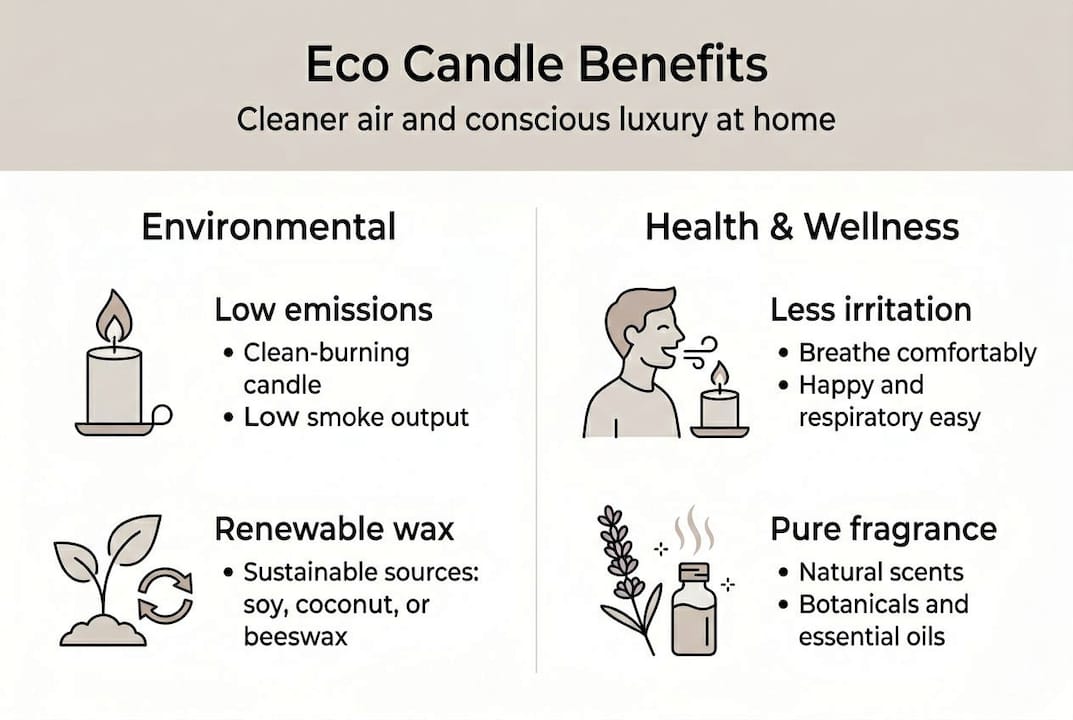
The benefits of sustainable candles extend beyond environmental impact. Cleaner materials mean fewer airborne irritants, better indoor air quality, and a more genuine wellness experience. The artisanal candle making process, done in small batches, allows for greater quality control at every stage.
Preparing to choose: Your eco candle requirements
Understanding your own needs before browsing is the most efficient way to avoid a poor purchase. Eco candles are not one-size-fits-all. Fragrance sensitivity, household members, and intended use all shape the right choice.

Matching your lifestyle to candle type
| Requirement | Recommended wax | Fragrance approach |
|---|---|---|
| Vegan household | Soy, coconut, or rapeseed | Phthalate-free, plant-based oils |
| Allergy-prone | Soy, coconut, or rapeseed | Fragrance-free or hypoallergenic |
| Meditation or focus | Rapeseed or beeswax | Subtle, single-note scents |
| Strong scent throw | Rapeseed or coconut | High fragrance load (8-10%) |
| Gifting | Any certified wax | Elegant, recyclable packaging |
According to candle needs and allergies guidance, edge cases matter: those with bee allergies should avoid beeswax entirely, vegans should select soy or coconut alternatives, and anyone prioritising clean indoor air should look at beeswax or certified rapeseed options.
Special considerations worth noting before you buy:
- Pets: Some essential oils, including eucalyptus and tea tree, are toxic to cats and dogs
- Children: Opt for fragrance-free or very lightly scented options in nurseries
- Allergies: Synthetic fragrance is a common trigger; always check for phthalate-free labelling
- Meditation: Eco picks for meditation tend to feature grounding scents like sandalwood, vetiver, or cedarwood
- Home decor: Candle decor inspiration can help you match vessel style and scent profile to your interior
Pro Tip: When buying from an artisanal maker, ask for the batch number and production date. Reputable small-batch producers will share this information readily, and it tells you the candle is fresh and traceable.
Step-by-step: How to assess candle quality and eco credentials
Once you know what you need, evaluating a specific candle becomes methodical. Use this process whether you are shopping in a boutique or browsing online.
- Check the wax type and source. Look for named waxes with origin details. ‘Natural wax blend’ without specifics is a red flag. Soy wax is renewable and biodegradable but may be GMO or linked to deforestation if uncertified; beeswax excels for clean air but is not vegan.
- Verify certifications. Look for third-party logos, not just brand claims. USDA Organic, RSPO, and Nordic Swan are reliable indicators.
- Inspect the wick. Cotton or wood wicks are preferable. Metal-core wicks can release trace heavy metals when burned.
- Evaluate fragrance sourcing. Fragrance oils should be phthalate-free, paraben-free, and IFRA-compliant. Brands that design their fragrance oils in countries with strong regulatory standards, such as France, offer greater transparency.
- Assess the fragrance load. Mass-produced paraffin candles typically use only 2 to 3 per cent fragrance oil. Quality eco candles use around 10 per cent of total weight, which produces a noticeably fuller scent in the room.
- Examine the packaging. Recyclable, minimal, or reusable packaging reflects genuine eco commitment. Plastic wrapping or foam inserts undermine otherwise good credentials.
Signs of high-quality artisanal production:
- Named wax origin (e.g., European rapeseed, certified soy)
- Fragrance oil safety sheet available on request
- Small batch numbers printed on the label
- Reusable or recyclable vessel (e.g., glass, ceramic)
- Clear burn time and care instructions included
Pro Tip: Always ask the brand where their fragrance oils originate. Transparency on this point is a reliable signal of overall quality. Explore clean burning candles and eco-friendly wellness choices for further reference points when comparing options.
Common mistakes and how to avoid them
Even careful buyers make errors. The eco candle market has enough misleading marketing to trip up experienced shoppers. Knowing the traps in advance saves both money and frustration.
Common pitfalls to watch for:
- Greenwashing: Words like ‘natural’, ‘clean’, and ‘green’ carry no legal definition on candle labels. They mean nothing without certification to back them up.
- Unlabelled soy: Non-certified soy may be GMO or contribute to deforestation, making it no more sustainable than conventional alternatives.
- Synthetic fragrances: Many candles described as ‘botanical’ or ‘aromatherapy’ still use synthetic fragrance compounds that include phthalates, which are linked to hormone disruption.
- Plastic or non-recyclable packaging: A candle in a glass jar wrapped in single-use plastic is not a fully eco product, regardless of what the wax is made from.
- Paraffin blends: Some brands blend paraffin with soy or coconut wax and still market the product as natural. Always ask for the full ingredient list.
- Unverified cruelty-free claims: Without a recognised certification body, this label is unverifiable.
Exploring using scented eco candles and candle aroma therapy insights can help you build a clearer picture of what genuine quality looks like in practice.
“Always seek independent certifications, not just buzzwords, for true eco value.”
The safest approach is to treat any unverified claim with scepticism and ask for documentation. Brands with nothing to hide will provide it.
Our perspective: What most eco candle guides overlook
Most guides stop at wax type. That misses the bigger picture. The supply chain behind a candle, who grows the raw materials, where the fragrance is formulated, how the product is packaged and shipped, matters as much as the label on the front.
Local, small-batch production is not just a marketing story. It means shorter supply chains, greater accountability, and a maker who can actually answer your questions. When you buy from a queer-owned, Amsterdam-based studio producing candles in small batches, you are not just buying a product. You are supporting a transparent, values-driven process.
Fragrance is another overlooked area. Most guides treat it as secondary. In reality, fragrance quality determines both the wellness experience and the safety profile of a candle. Phthalate-free, IFRA-compliant oils designed specifically for candle performance are a meaningful differentiator, not a minor detail.
Asking ‘who made this’ is the single most useful question in the eco candle market. Artisanal production for wellness is where genuine sustainability and genuine luxury actually meet.
Discover our artisanal eco candle collection
If this guide has clarified what to look for, the next step is straightforward. At Mikalma, every candle is made in small batches in Amsterdam using 100% European rapeseed wax. Fragrance oils are vegan, phthalate-free, paraben-free, cruelty-free, and IFRA-compliant, designed and produced in France at 10% fragrance load for a genuine room-filling scent.
The SANCTUARY scented candle is a good starting point for anyone building a daily calm ritual. Packaged in a timeless black glass jar with fully recyclable materials, it reflects every standard covered in this guide. Browse the full range of eco candle accessories to complete your ritual, from wick trimmers to snuffers, all chosen with the same care.
Frequently asked questions
What makes a candle truly eco-friendly?
A truly eco-friendly candle uses renewable wax, clean-burning wicks, natural fragrances, and carries verification from a recognised eco-label. Key certifications include USDA Organic, Rainforest Alliance/RSPO, Cruelty-Free/Vegan, and the Nordic Swan Ecolabel.
Are soy wax candles always sustainable?
No. Soy wax candles are only sustainable when the soy is certified to avoid GMOs and deforestation risks. Uncertified soy can be as problematic as conventional alternatives.
Which candle wax is best for people with allergies?
Coconut or soy wax is generally better for allergy-prone individuals. Beeswax should be avoided by anyone with a bee or honey allergy, and fragrance-free options are safest for sensitive households.
Why are certifications important when choosing eco candles?
Certifications confirm that sustainability claims are verified by an independent body, not just stated by the brand. Independent eco-labels such as USDA Organic and the Nordic Swan Ecolabel provide the most reliable assurance.