

How to choose eco-friendly candles for wellness
TL;DR:
- Truly eco-friendly candles use renewable waxes like beeswax, coconut, or responsibly sourced rapeseed.
- Components like lead-free wicks, fragrance ingredients, and recyclable packaging are essential for sustainability.
- Choosing natural, transparent, and certified candles supports better indoor air quality and ethical production.
Not every candle labelled “natural” is genuinely eco-friendly. Many contain hidden ingredients, from petroleum-based waxes to synthetic fragrance chemicals, that affect both the planet and your indoor air quality. The difference between a truly sustainable candle and a greenwashed one often comes down to five core factors: wax source, wick material, fragrance composition, packaging, and burn quality. Understanding each of these gives you a clear framework for making choices that support your wellness and align with your values. This guide covers all five, with practical detail on certifications, materials, and what to look for on product labels.
Key Takeaways
| Point | Details |
|---|---|
| Choose renewable wax | Beeswax, coconut, and plant waxes outperform paraffin and palm in sustainability and burn quality. |
| Prioritise verified clean burn | Look for candles with low soot and VOC emissions, ideally tested and certified for indoor air safety. |
| Insist on ethical production | Ethical labour, cruelty-free sourcing, and clear certifications ensure your purchase has a positive impact. |
| Opt for sustainable packaging | Refillable, recyclable packaging is crucial for reducing waste and supporting eco-friendly values. |
| Value artisan craftsmanship | Premium artisan eco-candles enhance wellness and décor, offering traceable origin and greater longevity. |
Understanding eco-friendly wax choices
Wax is the foundation of any candle, and it is also the most significant factor in determining environmental impact. Not all plant-based waxes are equal, and the source matters as much as the material itself.
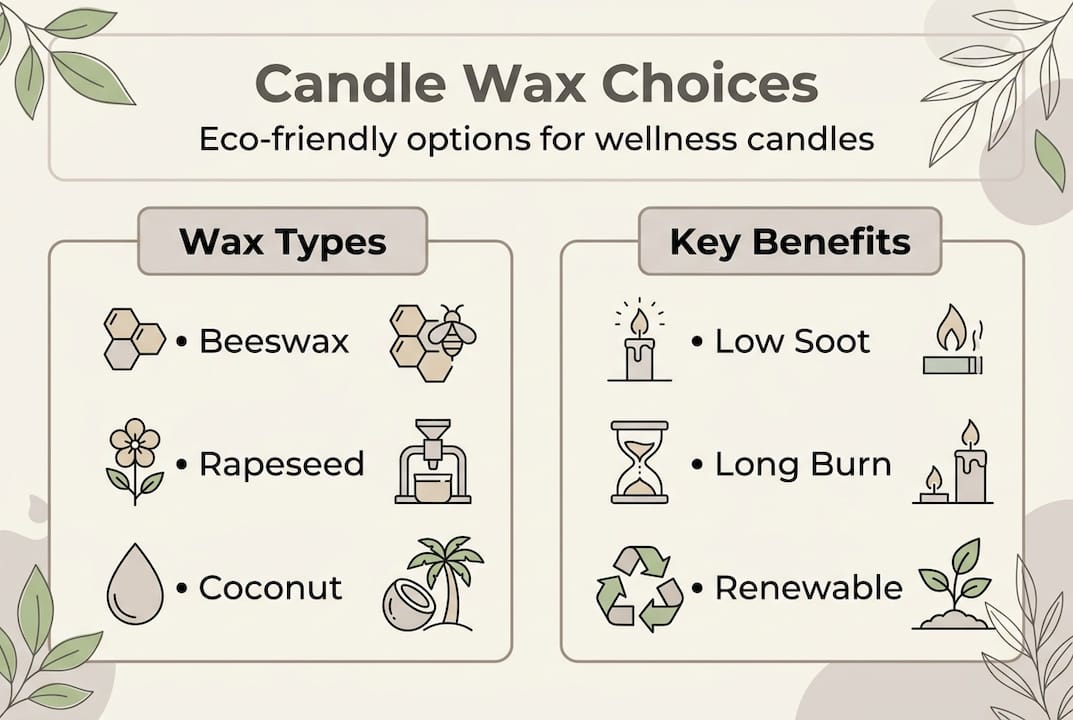
Eco-friendly candles use renewable waxes like beeswax, coconut, or responsibly sourced plant waxes, avoiding paraffin, which is petroleum-based, and often palm or soy due to deforestation risks. Paraffin is the most widely used candle wax globally, yet it is a by-product of crude oil refining. Burning it releases soot and volatile organic compounds (VOCs) into your home.
Soy wax is frequently marketed as a green alternative, but the reality is more complicated. Most commercial soy is grown in regions where deforestation is an active concern, and the supply chain is rarely transparent. Palm wax carries similar risks. Coconut wax performs well and burns cleanly, though it is typically imported from Southeast Asia, which increases transport emissions.
Rapeseed wax, grown across Europe, is a strong alternative that is often overlooked. At mi KALMA, we use 100% natural European rapeseed wax after extensive testing across natural wax types. It delivers a clean, stable burn with excellent scent throw, and because it is grown locally, the transport footprint is significantly lower than imported alternatives. It is also fully vegan and renewable.
The Nordic Swan Ecolabel requires at least 90% renewable materials by weight and bans palm oil, soy oil, and paraffin outright. This standard is one of the most rigorous in the industry.
| Wax type | Renewable | Burn time | Soot level | Eco concern |
|---|---|---|---|---|
| Paraffin | No | ~60 hrs | High | Petroleum-based |
| Soy | Partly | ~50 hrs | Low | Deforestation risk |
| Coconut | Yes | ~60 hrs | Very low | High transport miles |
| Beeswax | Yes | 110+ hrs | Low | Not vegan |
| Rapeseed | Yes | ~60 hrs | Low | European grown |
Key things to look for when assessing wax:
- Clearly stated wax origin, not just “natural wax”
- Certification from a recognised body
- Locally or regionally sourced where possible
- No blending with paraffin
Pro Tip: If a brand cannot tell you where their wax comes from, that is a signal worth noting. Traceable origin is a basic standard for any premium artisan candle. Explore best candle wax options and rapeseed vs soy wax comparisons to go deeper on this.
Wick, fragrance and packaging: overlooked essentials
Once wax is sorted, the next layer of sustainability lies in the components most people overlook: wicks, fragrances, and packaging. Each one has a direct impact on both your health and the environment.
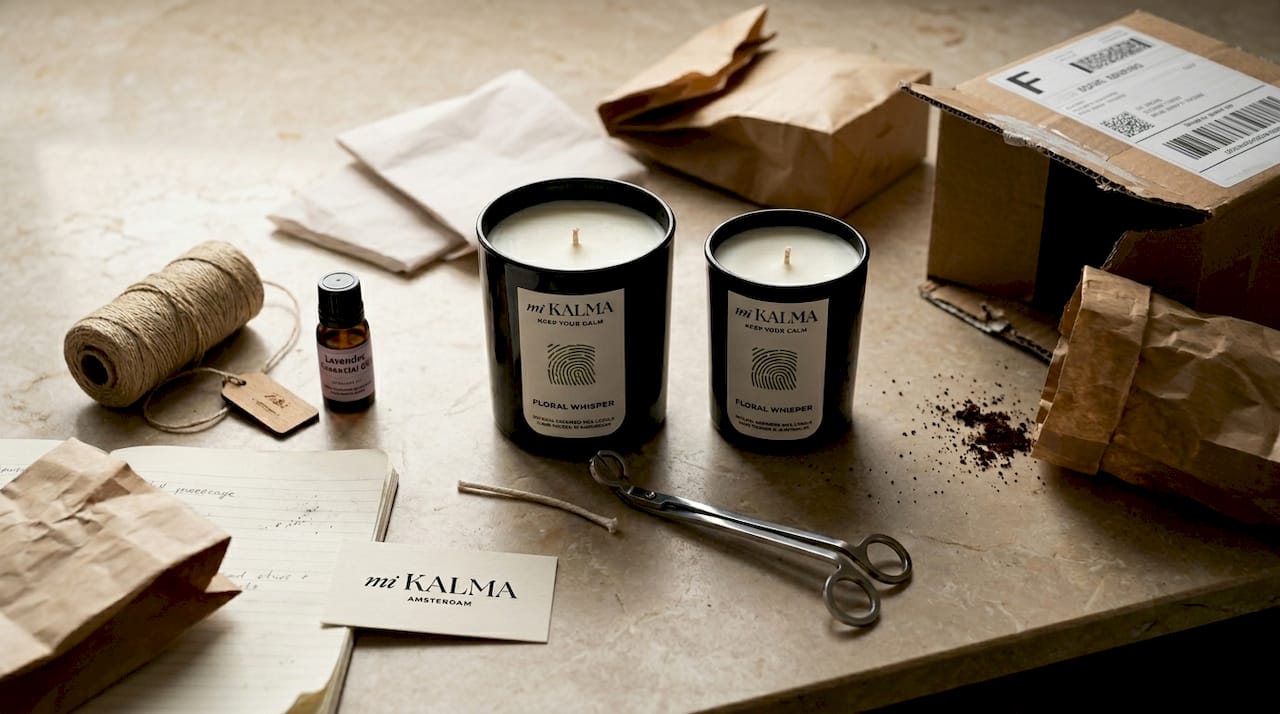
Wicks must be lead-free, typically made from cotton, hemp, or FSC-certified wood. Lead wicks were banned in many countries years ago, but some imported candles still use metal-core wicks that can release trace toxins when burned. Cotton and hemp wicks burn cleanly and consistently. Wooden wicks add a soft crackling sound and tend to produce a wide, even melt pool.
Fragrance is where many candles fall short on transparency. Fragrances should be phthalate-free, with essential oils preferred, and some certification standards ban synthetic scents entirely. Phthalates are chemical compounds used to make fragrance last longer, but they are linked to hormone disruption and indoor air pollution.
At mi KALMA, our fragrance oils are vegan, phthalate-free, paraben-free, cruelty-free, and IFRA-compliant. They are designed and produced in France specifically for candle performance. We use 10% fragrance oil by total weight, which is significantly higher than the 2 to 3% used in mass-produced paraffin candles. That is why the scent throw is noticeably stronger and longer-lasting.
Sustainable packaging includes recyclable and biodegradable materials, with minimal plastic and refillable systems that reduce waste. Our candles come in timeless black glass jars with fully recyclable outer packaging. The jars themselves are designed to be reused or refilled, reducing the need for replacement.
What to check on any candle’s packaging:
- Wick material clearly stated
- Fragrance disclosure: phthalate-free, IFRA-compliant
- Recyclable or biodegradable outer packaging
- Refillable container option
- No unnecessary plastic wrapping
Pro Tip: Brands that list every ingredient, including fragrance components, are the ones worth trusting. Opacity in this area is rarely accidental. Find out more about how to choose eco-friendly candles and the sustainable candle benefits that go beyond the label.
Clean burning and indoor wellness: science behind the flame
Now that we have explored materials, it is time to look at how burning impacts both your indoor environment and the planet.
When a candle burns, it releases particles and gases into the air. With paraffin, those include soot, benzene, and toluene, all of which are classified as VOCs. In a small, enclosed room, repeated exposure adds up. Natural waxes produce up to 90% less soot than paraffin, making them a substantially cleaner option for indoor use.
This matters for wellness, not just the environment. Cleaner burning candles support better air quality, which is directly linked to mood, sleep, and respiratory health. Pairing a clean-burning candle with a calming scent creates a more effective relaxation ritual than any synthetic alternative.
“Certifications like the Nordic Swan Ecolabel ensure at least 90% renewable materials, low emissions, no hazardous chemicals, and fire safety compliance.”
Steps to verify clean burn quality:
- Check for third-party certification (Nordic Swan, RAL Quality Mark)
- Look for independent emissions testing results
- Confirm the wax type and its known soot profile
- Assess wick size relative to container diameter
- Check for a clean, even melt pool in product reviews
Beeswax burns for over 110 hours compared to paraffin at around 60 hours, and coconut wax is similarly low in soot. Longer burn times also mean fewer candles purchased over time, which reduces both cost and packaging waste.
Pro Tip: No candle is completely soot-free. Even the cleanest natural wax will produce trace particles if the wick is too long or the candle is placed in a draught. Trim your wick to 5mm before each burn for the best results. Explore clean burning candle options and the science of candle aroma therapy for further reading.
Certifications, artisan values, and ethical production
For discerning buyers, the story does not end at materials or burn. Ethics and provenance are just as vital.
Certifications provide an objective benchmark. The Nordic Swan Ecolabel is one of the most respected, covering material sourcing, emissions limits, chemical restrictions, and fire safety. The RAL Quality Mark from Germany is another credible standard focused on burn performance and safety. Both require independent testing, not just self-declaration.
Beyond certification, traceability, ethical labour, and cruelty-free production are markers of a genuinely responsible brand. A premium artisan candle should come with a clear story: where the wax was grown, where the fragrance was developed, and how the candle was made.
mi KALMA is a queer-owned small business based in Amsterdam. Our candles are handcrafted in small batches, which allows for quality control at every stage. Small-batch production also means less waste, more intentional sourcing, and a direct relationship between maker and product.
What to look for in an ethically produced candle:
- Named wax origin and supplier transparency
- Cruelty-free and vegan certification where applicable
- IFRA-compliant fragrance
- Clearly stated production location
- Small-batch or handcrafted process
- Refillable or reusable container
Pro Tip: A certification label on the front of a candle is only as meaningful as the process behind it. Look for brands that explain their supply chain in plain language, not just display a logo. Read more on artisanal candle benefits, candle craftsmanship, and why sustainable candles matter.
Our take: eco-friendly candle choices that matter most
Most eco-candle guides focus on wax type and stop there. In practice, the full picture is more layered.
No candle is entirely emission-free. What you are choosing between is a low-impact option and a high-impact one. For daily wellness rituals, that distinction matters. Rapeseed wax, European-grown and locally processed, is one of the most practical choices available right now. It performs well, it is vegan, and it avoids the supply chain issues of soy and palm.
Fragrance transparency is underrated. A brand willing to disclose every ingredient, including IFRA compliance and phthalate-free status, is demonstrating a level of accountability that most mass-market candles do not meet. That accountability extends to packaging, labour, and sourcing.
Refillable containers are not just a nice feature. They represent a genuine reduction in lifecycle waste. If you burn candles regularly, switching to a refillable system over a year makes a measurable difference.
Our artisanal candle expertise points to one consistent finding: the brands that are most transparent are also the ones that perform best. Quality and ethics tend to travel together.
Upgrade your eco-candle experience
If your new understanding of eco-friendly candles has you ready to make a change, the natural wax candle collection at mi KALMA is a practical starting point.
Our Sanctuary scented candle uses 100% European rapeseed wax, a phthalate-free IFRA-compliant fragrance developed in France, and a cotton wick in a reusable black glass jar. Packaging is fully recyclable. Every candle is handcrafted in Amsterdam in small batches. For those looking to complete the ritual, our candle accessories include wick trimmers and snuffers designed to extend burn life and maintain clean performance. Sustainability, quality, and calm, all in one place.
Frequently asked questions
Which waxes are genuinely eco-friendly for candles?
Beeswax, coconut, and responsibly sourced plant waxes such as rapeseed are considered eco-friendly due to their renewability, while paraffin, palm, and soy are discouraged because of petroleum origins or deforestation risks.
Do eco-friendly candles improve indoor air quality?
Yes. Natural waxes produce up to 90% less soot than paraffin, resulting in lower VOC emissions and a cleaner home environment with regular use.
How do I identify cruelty-free and ethically sourced candles?
Look for brands that publicly disclose their supply chain, carry recognised certification labels, and clearly state their position on ethical labour and cruelty-free production practices.
Are refillable candle containers more sustainable?
Yes. Refillable glass or ceramic jars reduce packaging waste significantly and extend the useful life of the container, lowering the overall environmental footprint of your candle habit.